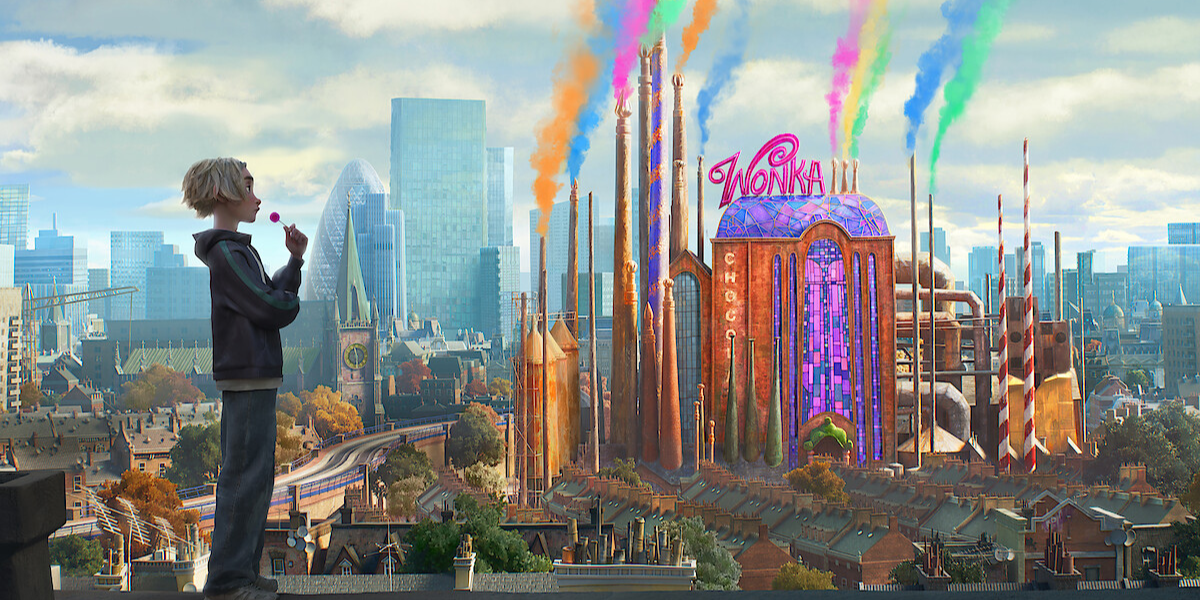
I’ve been reading up on the new press material of the upcoming adaptation of Charlie and the Chocolate Factory. Somewhat surprisingly, I’m left with more questions than before this was all released!
What’s most striking to me is that the storyline is so far removed from Roald Dahl’s Charlie and the Chocolate Factory (1964) and Charlie and the Great Glass Elevator (1972) – texts which previous press material explicitly stated were going to be used in the adaptation. If you haven’t seen this, the plot is set after the events of Charlie and the Chocolate Factory: Willy Wonka has been in prison for five years for turning Violet Beauregarde into a blueberry and, upon his release, he returns to the factory at the same time as Charlie Paley (a new Charlie…!) and his pals are trying to break in and steal a Wonka bar to raise money to avoid eviction. [1]
None of these events mirror the narratives in Dahl’s two books. It feels a little like a bait and switch – but not a wholly surprising one, as Netflix have always said that they wanted to “expand the Dahl universe” with new media. One such way they have expanded this is the entirely new premise for The Twits (2025) which not only had new characters, but entirely new storylines for the titular villains – and the Muggle-Wump family’s origins were rewritten, too, which created an intertextual link with Dahl’s Charlie and the Chocolate Factory. In the 2025 Twits film, the Muggle-Wumps originated from Loompaland, not Africa as was stated in the text (1980). It’s clear that Netflix are extending the IP by creating new narratives rather than remaking the texts.
There are no mentions of the Buckets in the press materials I’ve seen – and the fact that Charlie Paley is trying to break in and steal a Wonka bar indicates they’re not widely available in stores. It sounds as though the factory ceased production when Wonka was imprisoned… Did he renege on his offer to the Buckets of giving Charlie the factory? Did Wonka’s assets become seized by the authorities upon his conviction? Did the Oompa-Loompas unionise and abandon ship? Could the Buckets not cope with the bad press when Wonka was going through the trial? Who knows! I for one am most intrigued by this specific rewriting, given that Charlie Bucket is often credited as being the nicest part of the book (however boring a character I personally think he is…).
An interesting parallel is the theme of poverty from the source text and the new film (slated for a 2027 release). The Buckets, famously, are impoverished: they have one salary earner, four aging grand/parents, and never have enough food. Notably, though, the Buckets are depicted in line with the ‘poor, but happy’ trope which plagues much of fiction in its idealisation of poverty. Those who endure it without moaning are portrayed positively; when their circumstances change, they have ‘earned’ it through their stoicism and gratitude. It’s a problematic portrayal of destitution because it implies that those who are frustrated, desperate, or depressed because of it are unworthy of social mobility or financial stability because they have not evidenced their ability to tolerate destitution in a way which appeases those in the upper classes and positions of privilege. Such is the case with Charlie Bucket: he does not complain, he wants but does not beg for chocolate (his favourite food in the world) and shares the singular annual chocolate bar he receives. So when he is given the factory by Wonka, he has ‘earned’ it by not complaining about his dire situation.
With Charlie Paley, however, it appears that the modernisation of the cultural context (2027, over 70 years removed from the text’s 1964 publication date) has impacted his character arc. He is taking assertive action to change his impoverishment. Having been served an eviction notice, evidently he (and/or his family) are facing financial difficulties. Instead of waiting for those in privileged positions to change his circumstances, however, he does it himself. Notably, this is through theft. Inevitably the film will sympathise with Charlie and justify the theft (it is only chocolate, after all) and I wouldn’t be surprised if Wonka was at first resistant to Charlie Paley’s actions but once hearing of his story, his stance will change.
I also anticipate that social media criticism will be present in the film, to mirror Dahl’s own anti-teleivision stance. Perhaps Charlie and their friends will film their endeavours to break into the factory? This would heighten the effect of time passing during Wonka’s sentence, in that it would show that the world has moved on without him and he need to find his place in it again.
Interestingly, the reimagined factory has a religious, church-like appearance with its colourful, stained-glass windows. So the themes of virtue, honesty, and charity will implicitly be configured with the building, too. It’s the most colourful exterior of the factory to exist – in either text or adaptation.
I’m intrigued by the sudden pivot by the change in format: since its first announcement, this project has always been referred to as a series. Every time. But now, it’s a feature film. This is exactly what happened with The Twits (I had people involved with the production reach out to me on social media to confirm this). I remember with this film that I commented upon its episodical structure and its unwieldy cast size – too many minor characters were introduced and plots were sped through at quite a pace in a way that felt chaotic. It transpired that the higher-ups were so pleased with The Twits animation that they wanted to release it as a film, not a series – which meant a whole lot of editing had to take place. No wonder it felt so quick: they had to condense hours of content into a 1.5hour film! It appears, to me, that the same has happened with the Charlie and the Chocolate Factory feature. So I wouldn’t be surprised if that fast-paced episodical structure negatively impacts the timing of this feature, too.
I am intrigued, though, by the look of the animation. The colour palette is gorgeous and the benefit of this being an animate production is that fewer rules of reality have to be followed – the creators and animators can use whimsy, fantasy and colour in whatever way they feel fits! So I’m excited to see the back-and-forth between Wonka and Charlie 2 and the gravity-defying theatrics as Charlie tries to break into the factory.
One thing, though, that I just can’t shake: is it just me, or does this remind you of the band The Gorillaz? Something about the stance and shape of the character’s face (I’m presuming this is Charlie 2) makes me think of them!
[1] Interestingly, this totally contradicts a follow-on book published by Puffin in 2025. In Charlie and the Christmas Factory, Violet returns to the factory when Charlie Bucket is running it; she is grateful to have been turned into a blueberry, because it gave her a new take on life and helped her become the person she is.
Header image: copyright Netflix, sourced from this article.

