
Arguably one of Dahl’s most popular and famous books, Charlie and the Chocolate Factory is recognised for its whimsical characters and snarky comedy. But there’s one aspect of the book which has stirred up controversy over the years: the characters of the Oompa-Loompas. These are the characters which have seen the most change – why? What is it about the Oompa-Loompas that make them a target for reinterpretation?
Roald Dahl’s Charlie and the Chocolate Factory was originally published in 1964, in the midst of the US Civil Rights Movement (1954–68). Knowledge of the Oompa-Loompas’ appearance in this edition has come to be a dinner-party anecdote (did you know that they were originally black Pygmies from Africa?) but at the time there was little controversy surrounding it. Perhaps this was because the book wasn’t an immediate bestseller – at least, not enough to truly cause a stir.

In the original book, we learn that Willy Wonka “smuggled [the Oompa-Loompas] over in large packing cases with holes in them”, like animals; they live and work in the factory with no monetary compensation, working only for cacao beans. Willy Wonka even tests out his new products on them sometimes to dire effects; twenty Oompa-Loompas try the three-course-meal gum and “finished up as a blueberry” like Violet Beauregarde (p.116). It doesn’t take too discerning a reader to make the obvious slavery allusions – of which Dahl claimed innocence: “It didn’t occur to me that my depiction of the Oompa-Loompas was racist.”
When the Mel Brooks 1971 Willy Wonka and the Chocolate Factory film was in production, however, the NAACP called for a boycott of the film unless the Oompa-Loompas’ appearance changed. I agree with Chryl Corbin’s statement: “As theatres became integrated African Americans became a capitalist venture for Hollywood in which derogatory depictions of blacks also meant a loss in revenue. This was the major consideration for changing the Oompa-Loompas from their original depictions as black Pygmy people from Africa.” Had the NAACP not threatened to boycott the film, I wonder how long it would have taken for the Oompa-Loompas to be revised. The first reinterpretation, then, appears to come from a place of removing racist connotations and financial gain.
For the 1971 film the Oompa-Loompas’ appearance changed to the now-iconic orange skin and green hair. The new look created enough of a barrier between the film and accusations of racism; the Oompa-Loompas became fantasy creatures.
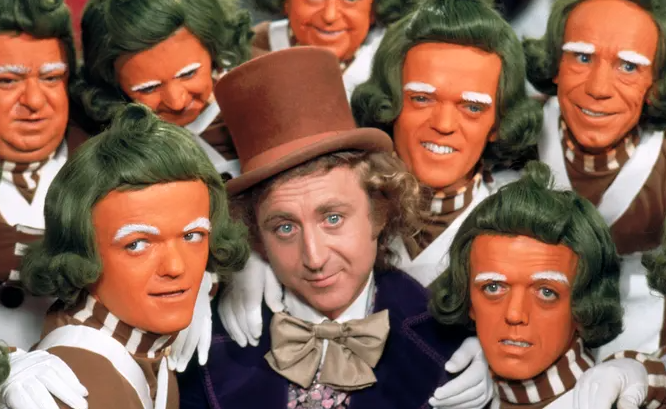
Dahl said that “after listening to the criticisms, I found myself sympathising with them, which is why I revised the book”. This statement was made in 1973, the year that Charlie and the Chocolate Factory was republished with a different look for the Oompa-Loompas. If Dahl had made this statement in 1971, in support of the changed film version of the Oompa-Loompas, it would perhaps carry more bearing. But to make it coincide with the book’s re-release undermines its sentiment.
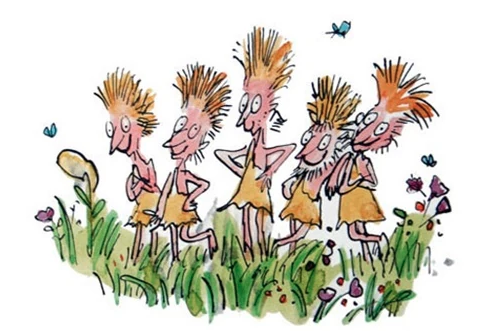
Already, by 1973 we’ve had three iterations of Oompa-Loompas: Dahl cose not to adopt Mel Brooks’ version of the Oompa-Loompas, instead opting for fairytale creatures with light skin, brown hair and deerskins. The nationality of the Oompa-Loompas have changed from being African to being from “Loompa-land” (do note that Wonka still says that they have been “imported direct”, like possessions). This reinterpretation of Dahl’s may be partly motivated by his dislike of Brooks’ film, but also to further deflet any accusations of racism by inventing a new creature to work in the factory.
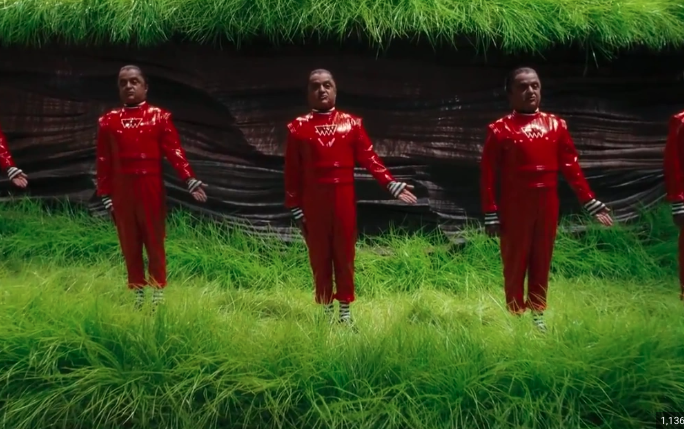
The Oompa-Loompas changed again in 2005, when Tim Burton adapted Charlie and the Chocolate Factory and cast Deep Roy in the role. Using CGI, Deep Roy played every Oompa-Loompa, making them completely uniform in action and appearance. This adds a sci-fi element to the film and presents the Oompa-Loompas as clone-like figures. While Deep Roy adds some diversity to this otherwise all-white cast, this unfortunately does re-inject some of the slavery associations into the film; the power dynamics are such that again, people of colour are sources of labour for their white masters. Burton’s accepted reputation as an auteur means that he is known for working with the same select actors; Deep Roy is one such actor, alongside Johnny Depp and Helena Bonham Carter. Chryl Corbin writes that this reinterpretation of the Oompa-Loompas could relate to the anxiety of the white workforce due to the outsourcing of jobs: “this is also the first depiction of Oompa-Loompas with technology, they are now depicted as Indians and are connected to the usurping of American jobs through outsourcing made possible by the world wide web”. She also points out that in this film, the Oompa-Loompas have been effectively branded with “WW” for Willy Wonka on their uniforms, presenting them as property.
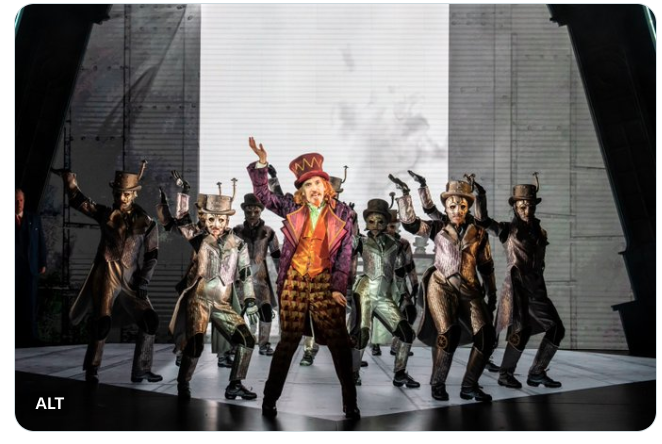
The Oompa-Loompas remained untouched until 2013 when David Greig, Marc Shaiman and Shaiman and Scott Wittman wrote Charlie and the Chocolate Factory: the Musical[1]. In this version, first directed by Sam Mendes, the Oompa-Loompas are robots without a backstory or explanation. They are merely introduced by a single line (“here are the Oompa-Loompas!”) by Wonka. Their appearance matches the exterior of the factory onstage; it first appears as a steampunk door wrought from copper and iron. This reinterptration means that the Oompa-Loompas then become another one of Wonka’s creations, just like his chocolates. This has some implication for their judgements of the five children: if they have been programmed by Wonka, their understanding of ‘good’ and ‘bad’ has been learned from him. Whereas previous iterations of the Oompa-Loompas have a degree of agency and can form their own opinions, these mechanical versions are acting as programmed – that is, unless Wonka has given them sentience.
The robotic appearance aligns with Corbyn’s interpretation of the Oompa-Loompas being reimagined in line with industrialised fears; a robotic workforce is emblematic of the fear of AI and automated work processes.
And earlier this year, the trailer for the upcoming Wonka film (starring Timothee Chalamet and directed by Paul King) revealed that the Oompa-Loompas are modelled after Brooks’ 1971 film. The film is a prequel in the canon, offering the story of how Wonka rose to prominence. The trailer implies there is only one Oompa-Loopma, portrayed by Hugh Grant who has been following Wonka around.
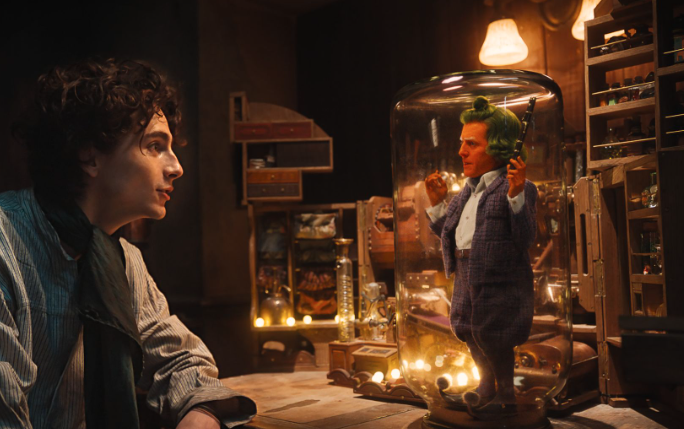
This single line – and I must caveat this by saying I have not seen the film as it’s not released in the UK until December 2023 – revises the origins of the Oompa-Loompas in the 1964 source text. Instead of being “smuggled” in, Paul King’s Oompa-Loompa chooses to follow Wonka to the country. This raises a few questions: how do so many come to be in Wonka’s future factory? Will they be clones (like Deep Roy) or multiple actors (as in Brooks’ film) or does Wonka go back to Loompa-Land and “smuggle” more into England? There’s also the question of whether the upcoming Netflix series, set to be directed by Taika Waititi, is a follow-on from Wonka or is a standalone project.
All to be revealed, I suppose!
[1] By the way, this is one of the worst musicals I have ever seen. If you have the chance to go, don’t invest too much; get the cheap seats.


Outrageous designs, probably?
LikeLike
Possibly! I’m yet to discover exactly *who* in the 1971 film created the look for the Oompa-Loompas; given that they are human-adjacent in the texts, this is the decision that has given free rein to later costuming. Just interesting that most other elements are very similar (even the look and feel of the factory in a lot of ways) but each production wants to bring something new to the Oompa-Loompas.
LikeLike