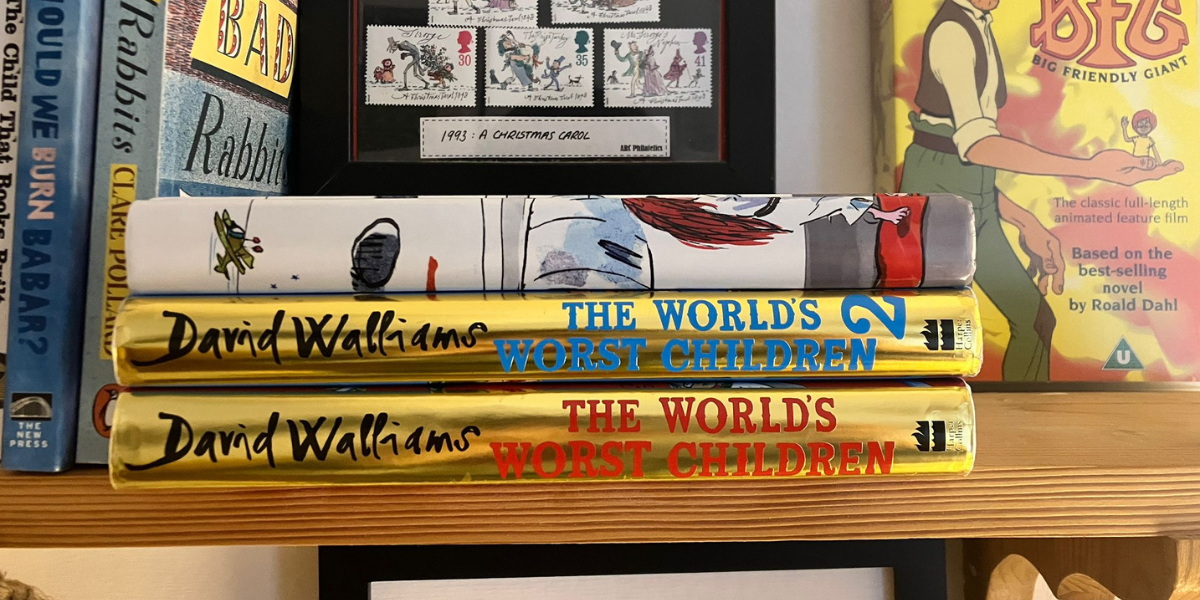
I’ve been thinking a lot about David Walliams since news broke that he was going to be dropped by his publishers amidst various misconduct allegations.
Now, I’m not a PhD scholar on Walliams – but I am a PhD scholar on Dahl, who Walliams is frequently compared to.
I haven’t wanted to comment on anything until I’d done some more research (because for a while the extent of the comment I could make was “yuck” aimed generally at Walliams’ direction).
But then I spotted a few clues about how Walliams’ reputation as the “new Roald Dahl” has been manufactured…and it appears that, actually, much of Walliams’ success feels artificial.
Here’s how Little Britain’s David Walliams Became the New Roald Dahl
David Walliams: Why I love Roald Dahl
David Walliams on being compared to Roald Dahl
Is David Walliams the new Roald Dahl?
So what justifies or explains their comparison? I believe it largely centres on the fact that Walliams’ books are controversial: they are subversive and violent in ways which are thinly veiled behind humor. It’s almost as though the shock factor makes you laugh rather than actual comedic content. This finds parallels in Dahl’s work – indeed critic Sam Leith says that “if you take the nastiness out of Roald Dahl you’re removing something absolutely fundamental to the success of the stories” (Haunted Wood, 2025). Spite and cruelty abound in both Dahl and Walliams’ works. I wonder if part of Walliams’ moniker as the “new Roald Dahl” allowed him to push the boundaries of what would be acceptable in children’s works – standing on the shoulders of the giant Dahl and deflecting accountability for any subversive elements of his works because if Dahl can do it, why not him too?
As with Dahl, the nastiness found in Walliams’ works predates his children’s works. Little Britain (2003–2006) made Walliams and his comedy partner Matt Lucas (who has his own controversies) household names; the humour of the show is underpinned by racism, sexism, transphobia, and ableism. You actually can’t find Little Britain on any streaming services now, I believe, because of this – that’s how offensive it is. I believe this subversive comedy has made its way into Walliams’ celebrity persona and thus his authorial persona. Again, this is similar to Dahl, who was always seen as a prickly or curmudgeonly man who also happened to write for kids; he wrote many violent and sexually sadistic stories for adults before he turned his hand to children’s writing. This serves as another justification of their comparison: their prickly, boundary-pushing, subversive personalities and narratives.
So they share nastiness. But the “new Roald Dahl” campaign extends far beyond Walliams attempting to embody a modernised version of the famous British writer: the endeavour appears to be championed extensively by his publishers. This is largely down to the visual identity of Walliams’ works being pastiches of Dahl’s works.
Dahl and Walliams share not one but two illustrators. Quentin Blake was Walliams’ illustrator for his first two books. This in itself isn’t exactly unique as Blake has worked on hundreds and hundreds (and hundreds and hundreds) of books including his own. But, what is notable is that Blake is absolutely integral to the Roald Dahl Brand. Blake’s handwriting is used by the Storytelling Museum, the Roald Dahl Marvellous Charity and Dahl’s books.[1] Blake’s handwriting is even used on the cover of a curated book comprised of letters Dahl wrote to his mother over the course of his life – Blake’s handwriting is used on the cover and spine, despite an entire book providing Dahl’s handwriting which they could have used.
Implicitly, this connects the two authors. Blake’s work is not 100% Dahl, but Dahl’s work is 100% Blake.
So the “new Roald Dahl” is a branding exercise which relies on Dahl’s name and Blake’s visuals. This fuses the two authors together because, essentially, Walliams’ books relies on the visual shorthand and connections readers make when they see Blake’s work. (“this is going to be like Roald Dahl, isn’t it?”) This packaging gives clues to the reader (and the reader’s parents, who likely would be familiar with Dahl’s work from their own childhood) about the type of book this is. The visuals suggest that if you like Dahl’s work, you’ll like this, too.
Now, Blake only started working with Dahl in 1978 – after Dahl had published numerous children’s books. They continued to work together until Dahl’s death in 1990, with a few exceptions. But in the mid-1990s, after Dahl had died, Blake was commissioned to be the exclusive illustrator for Dahl – so he created new drawings for the books which preceded their professional relationship. This solidified the brand (many different illustrators were used prior to this) and streamlined the Dahl brand identity.
But just before Blake was asked to do this, Tony Ross illustrated two works after Dahl had died (The Magic Finger and Fantastic Mr Fox). This is notable because after Blake stopped illustrating Walliams’ work, guess who stepped in? Tony Ross. He’s largely known for the Horrid Henry and Little Princess series and has a very visually similar style to Blake – many articles and interviews compare the two illustrators. They share an instantaneous, scratchy style – and again, there’s not only a connection to Dahl himself but to Dahl’s exclusive illustrator. There are all these heavy-handed clues as to what a reader might expect from a Walliams book, given how closely his works have been marketed as evocative of Dahl’s earlier (cherished by many) texts. Notably, Blake’s handwriting is still used for Walliams’ name on the book covers and spines.
So Walliams’ positioning as the New Roald Dahl is a very clever and expensive PR and branding exercise, I think. It’s not coincidental, it is constructed – and, dare I say, totally artificial.
[1] As of 2025, there appear to be concerted efforts to move away from Blake being the brand’s visual identity. New illustrators are used for new Dahl-related books (extending the IP of his characters under Puffin’s supervision), and the social media presence no longer relies on Blake’s handwriting or illustrations. Further, the Marvellous charity logo has changed from a Blake illustration of a crocodile in a nurse’s hat to a different illustrator’s version of a nurse. The various websites have all quietly been rebranded.
 rosiegailor