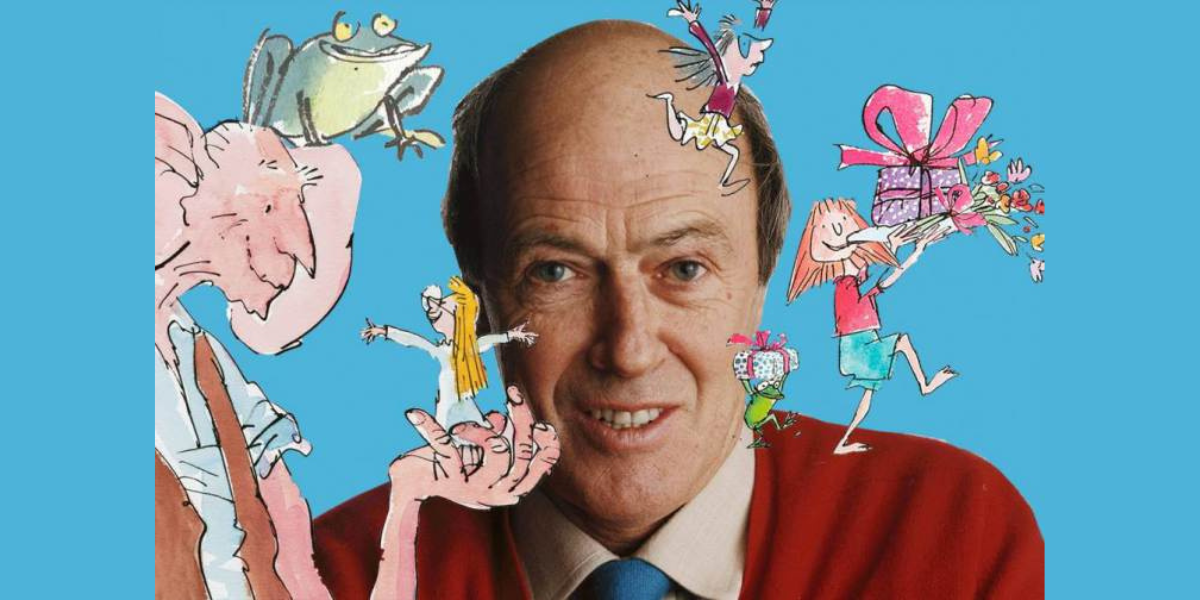
During Roald Dahl’s lifetime, with the exception of the first print run of Dirty Beasts (1983) and The Minpins (1991), Blake illustrated every Dahl book that was published since their first collaboration in 1978.
Dirty Beasts (I believe) had already been commissioned to Rosemary Fawcett by the time Dahl and Blake began working together, but after it was released (as I’ve explored, to not very positive reviews) Dahl wanted the Fawcett version to not be reprinted. The book was shortly re-illustrated and re-released with illustrations by Blake. Dahl then later felt that The Minpins required a different illustrative style as the book is a deviation from his usual comic tone, so went with Patrick Benson instead of Blake.
Blake and Dahl’s professional relationship lasted many years, and it actually continued even after Dahl’s death in 1991: by 1996, Blake had re-illustrated Danny, Champion of the World (1975), James and the Giant Peach (1961), Charlie and the Chocolate Factory (1964), The Magic Finger (1968), Fantastic Mr Fox (1970), and Charlie and the Great Glass Elevator (1972). It came to pass that the Dahl books in circulation were all re-/illustrated by Blake – even The Minpins, eventually, despite Dahl’s earlier wishes for a different illustrator.
This has continued into 2024 (though, as I’ve recently covered, the spin-off series ‘inspired by’ Dahl’s characters appear not to use Blake’s illustrations) . Controversially, Puffin announced that they had censored and edited Dahl’s works with suggestions from sensitivity readers. In response to backlash, Puffin backpedalled on this and decided to publish Dahl’s untouched books, rebranded as ‘the classic collection’, and Dahl’s censored works as a separate collection. Blake illustrations are used for both collections.
Blake’s illustrations are also used for periphery texts, too: the Roald Dahl Cookbook, various giftbooks, early learning books, and Dahl’s autobiographies. This also spilled over into the Roald Dahl Story Company branding; Blake’s illustrations adorn the walls of the Roald Dahl Museum and Story Centre in Great Missenden, is part of the Roald Dahl Story Company logo, and even the official Quentin Blake Font is used for many of Dahl’s book titles as well as marketing materials.
All this to say: Blake is central to the Roald Dahl brand as well as the texts. Almost to the point that Dahl and Blake’s works are conflated. The use of the Quentin Blake Font in particular is interesting to me: I noticed this first when reading Love From Boy, a collection of Dahl’s letters to his mother – of which she kept all of them (Dahl did not keep any of her letters). The cover of the book uses the Quentin Blake Font, but the cover’s design suggests that it is Dahl’s handwriting, lifted from one of his hand-written letters. That is not the case. This design choice may have been made with the idea of paying homage to the style of the children’s texts using the same font, but it actually raises an interesting implication on the overall authorship of the book. The letters were collated, edited, and reprinted as chosen by Donald Sturrock, so arguably it is his text – but the use of Blake’s handwriting, not Dahl’s, for the phrase Dahl used to sign off means that Blake is now imbued in the authority of the book. This is also the case for the autobiographies: Blake’s handwriting adds the personal touch, not Dahls, despite these texts being centred on Dahl’s own life.
Blake has become enmeshed and, actually, integral to both Dahl’s brand and stories – to me this suggests that Blake ultimately has more narrative control or authority, as the images are what are recognised as symbols of the works around the world, and are used for branding and marketing materials worldwide. The image appears truly to be king – I wonder if there is any research on memorability of slogans versus visuals in iconic adverts. And in terms of narrative authority and ownership of the texts…if Blake is more recognisably the look and feel of the Roald Dahl brand, isn’t it really the Blake brand?
Cover image owned by Abingdon Gallery, I believe.
 rosiegailor